
Clinical Trial:
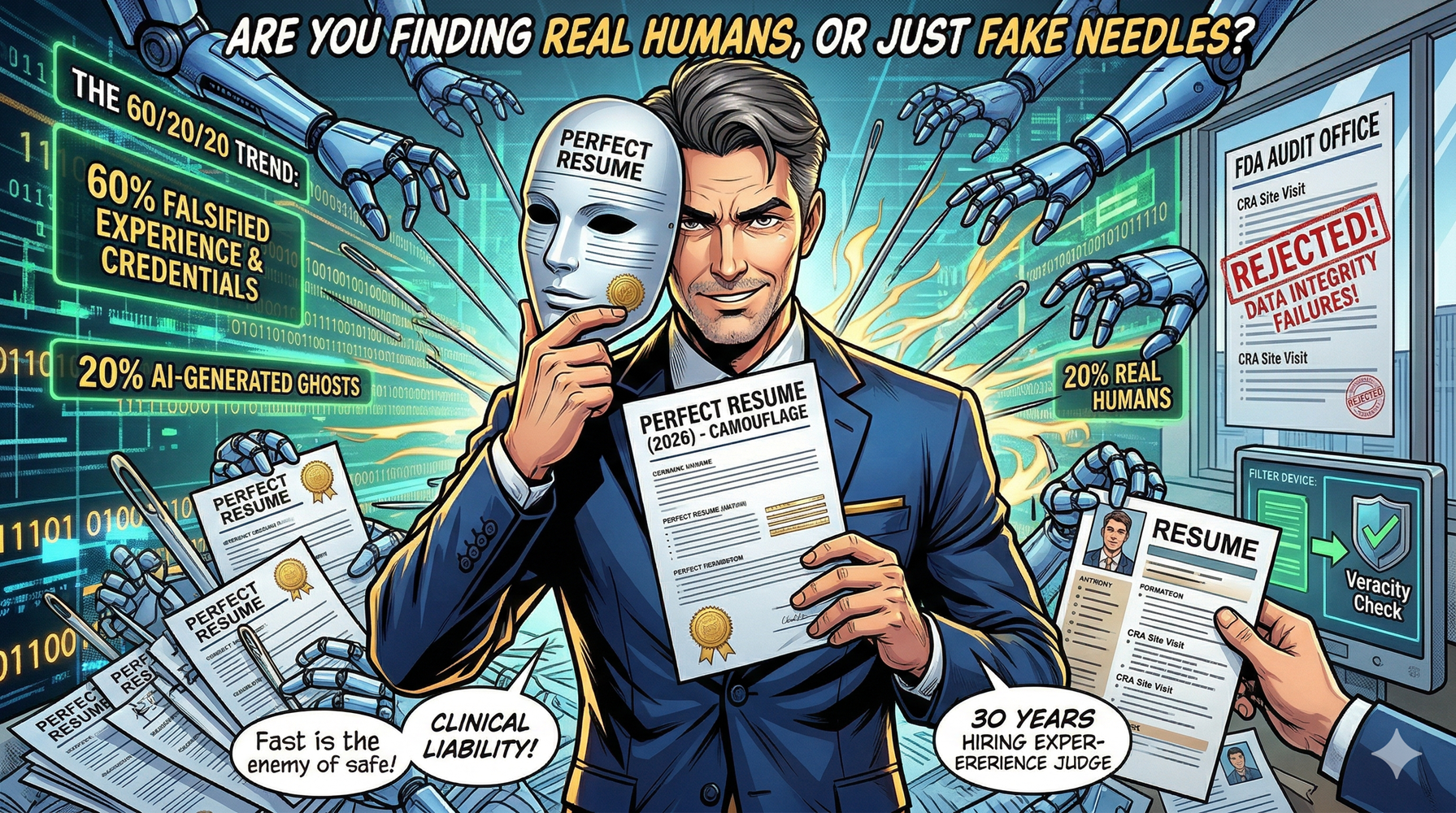
Why the 2026 “Trust Gap” is an Existential Threat to Clinical Research
This week was very much like most: my team and I flagged twelve fraudulent candidates. These weren’t just “embellished” resumes or slightly padded dates. These were sophisticated, coordinated attempts to bypass the vetting process for high-stakes clinical trial roles like Clinical Research Associates (CRAs) and Mid-level Management.
And what makes this scarier?
For most clinical trial hiring managers at small to mid-sized pharmas, biotechs, or medical device companies, these twelve individuals would have looked like the “perfect” hires. But in today’s market, the “perfect” resume is often a mask for a catastrophic risk.
The Anatomy of the 2026 “Trust Gap”
We are currently operating in what I call the 80% Noise Market. Based on our internal data and the current landscape of the Clinical Research sector, the applicant pool has fractured into three dangerous tiers:
- 60% are Falsified: These candidates have faked all or part of their experience, education, or references, often using sophisticated digital footprints that appear legitimate at first glance.
- 20% are AI-Generated: These are “ghost candidates.” They don’t exist but are AI-driven personas designed to farm interviews or collect sensitive company data.
- The “Real 20%”: These are the genuine professionals with real credentials. AKA…these are the ones you want to evaluate and qualify.
If your internal HR team is drowning in hundreds of applications, they aren’t just looking for a needle in a haystack. They are trying to identify a real needle in a pile of five hundred high-quality fakes.
Why the “Fast Hire” is the Enemy of the Safe Trial
I have spent over three decades in the hiring seat, including a decade in leadership at IBM. Before co-founding our firm, I was an executive at IBM, leading projects involving over 17,000 people.
I know the pressure you are under.
When you have a clinical trial to monitor or a department to scale, an empty seat feels like a bleeding wound.
However, in the Clinical Research world, a “bad hire” isn’t just an HR headache. It is a liability that can tank your company.
Let’s look at the Clinical Research Associate (CRA) role. CRAs are the primary line of defense for patient safety and data integrity. They operate with high independence, so a fraudulent CRA hire can go unnoticed for months, but the damage they leave behind is permanent:
- Patient Safety & Ethics: An unqualified person may miss protocol deviations or fail to verify informed consent. This isn’t just a paperwork error; it’s a direct threat to human lives.
- Data Integrity Failure: If the FDA or EMA identifies that your Source Data Verification (SDV) was handled by someone with falsified credentials, they won’t just ask for a correction. They can reject your entire dataset.
- The “Rework” Multiplier: The cost of a bad hire is often cited as $50,000. In Clinical Research, it is 10x that. Every site that a fraudulent CRA monitored must be re-monitored by a qualified professional. You are paying twice for the work and losing months of progress.
- Regulatory & Legal Fallout: We are seeing an increase in “negligent hiring” lawsuits. If a fake employee harms a study participant, the company faces millions in fines, and in extreme cases of GxP non-compliance, leadership can face criminal charges.
Finding the “Real 20%”
So, how do you navigate a market where 80% of the entries are noise?
It requires moving away from “Active” applicant pools and leaning into Passive Sourcing and Niche Partnerships. The high-quality, mid-career professionals you need are those with the resilience and adaptability to thrive in a startup or mid-sized environment. And guess what? They aren’t usually spending their time in a sea of AI-generated applications.
They usually don’t apply at all. Instead, they are working, being referred, and being vetted by people who know how to spot the “formulaic” interview answer and the “mismatched identity” red flags.
At my agency, we don’t just “find” candidates; we verify the unverifiable. We use our three decades of hiring expertise to protect your trial, your data, and your reputation.
You don’t have time to be a fraud detective, but you do have a clinical trial to run. Let’s make sure the people running it with you are the real deal. Don’t let a ‘ghost candidate’ become a regulatory nightmare. Message me today to learn how we identify high-quality CRAs in a market full of noise.
Sources and Additional Reading
- PharmiWeb: 2026 Recruitment Fraud Risks Report: Analyzes the “Applicant Avalanche” and the rise of automated/fake credentials in Life Sciences.
- CCRPS (Center for Clinical Research Practice): Their “5 Strategies to Prevent CRA Fraud” lists the specific red flags of candidates using generic “Formulaic” interviewing.
- FDA: GCP Inspection Findings & Data Integrity: Official reports highlighting how data integrity failures lead to trial rejection and market delays.
- ACRP: Elements of Fraud and Misconduct: Professional standards defining the red flags and ethical requirements for CRAs and monitors.
- U.S. Dept. of Justice: The Jessica Palacio Case: A case study on the criminal indictment of a study coordinator for falsifying clinical trial data.
- Inop.ai: 2026 True Cost of a Bad Hire: Quantitative research on the financial impact of hiring failures in specialized technical roles.
- Crosschq: 2026 Quality of Hire Report: Statistics on candidate misrepresentation and the “Trust Gap” in modern screening processes.
- Resume Builder: 2025 Candidate Survey: Data showing the percentage of applicants who admit to falsifying details on resumes and during interviews.