
Mid-Career Pivot:
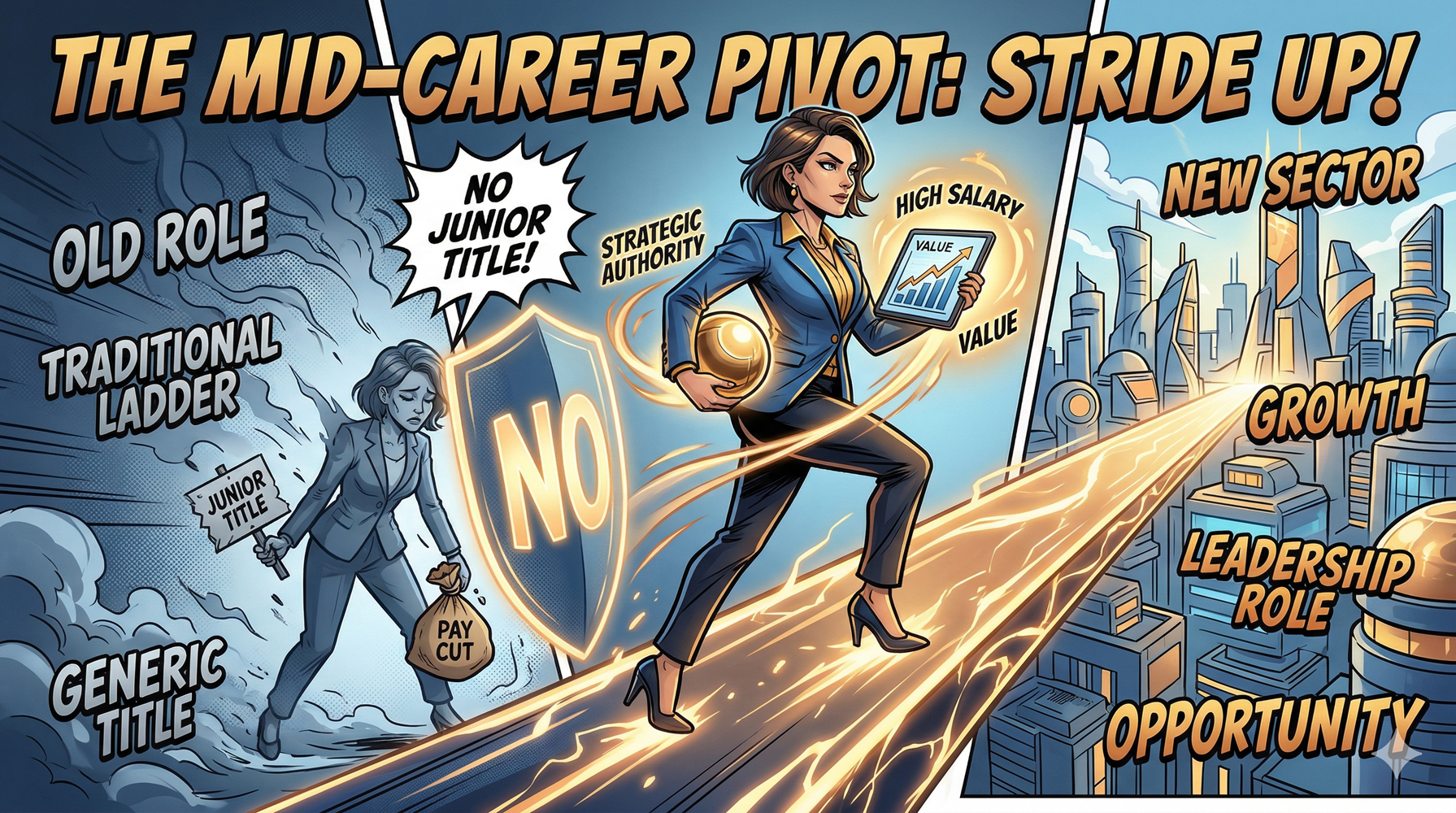
So you are sitting there late at night, scrolling through job boards, and you see it…an exciting role in a new industry that actually makes you feel alive again. But then you look at the fine print. The title says “Manager,” and the salary is roughly 40 percent less than what you currently bring home. You didn’t think a mid-career pivot would be such a challenge.
It is a punch in the gut.
The fear is immediate and loud: “I don’t want a reinvention that feels like a demotion.” You have worked too hard to go back to fetching coffee or asking for permission to take a long lunch.
And guess what? You don’t have. It is entirely possible to pivot laterally or even move up, provided you understand how seniority is actually evaluated when you step outside of your current bubble.
Where the Pay-Cut Fear Comes From
We have all been fed the same “traditional career ladder” story since we entered the workforce. You start at the bottom, you climb one rung at a time, and heaven forbid you try to jump to a different ladder. If you do, the “rules” say you must start at the bottom again.
This story breaks down completely when you hit mid-career. When you have 15 to 20 years of experience, you are no longer a beginner, and the ‘mid-career pivot’ is plausible.
But most professionals seeking a mid-career transition have a “Beginner on Paper” problem. Your resume is likely telling a story about where you have been, rather than what you are capable of doing. And if your resume focuses solely on industry-specific jargon, a recruiter in a new field will only see what you lack, rather than the mountain of expertise you bring to the table.
How Seniority Is Actually Measured
In the real world, seniority isn’t just about how many years you have spent in a specific seat. Most industries use specific signals to determine if you are a “heavy hitter” or a “junior.” They look at your scope of responsibility. Do you manage a budget? What is the headcount of your team? How complex are the problems you solve daily?
They also look at your decision-making authority. Do you own the risk if things go sideways? Are you leading strategic change or just following a manual? These signals translate across almost every sector. If you have managed a 10 million dollar budget in manufacturing, you have the financial literacy to manage a similar budget in tech. The “stuff” you are making might change, but the level of leadership doesn’t.
Three Ways to Protect Your Senior Status
Tactic 1: Lead with your functional level
Don’t get hung up on your past title. If you were a “Senior Account Executive in Manufacturing,” but you were essentially running the entire department, state that you performed as a “Head of Revenue Strategy.” Use terms that describe the function and the level of your work, not just the label your previous HR department slapped on your desk.
Tactic 2: Target roles with equivalent scope
Stop looking for familiar titles and start looking for familiar problems. Read job descriptions to find the size of the budgets and the size of the teams. If you are used to managing 50 people, don’t apply for a role that manages two, regardless of how cool the company is. You want to find a role where the “size” of the problem matches your current capacity.
Tactic 3: Use interviews to negotiate the level
When you get into the room, you need to ask the right questions to ensure you are not being under-leveled. Ask about decision rights. Ask who you report to and who reports to you. If the expectations they describe sound like junior work, address it right then. You can say, “Based on my experience managing high-stakes turnarounds, I am looking for a role with the authority to drive strategy at a senior level.”
When a Short-Term Step Back Is Strategic
Now, I am not saying you should never take a slight adjustment. I believe in ‘sling shot’ moments because there is a big difference between a temporary step back and a true demotion. A strategic mid-career pivot might involve a small title change or a minor pay dip if you are moving into a high-growth sector. Just make sure these trade-offs come with equity and a very clear path to promotion.
A true demotion, however, locks you into doing junior work with no realistic way to move up. Before you sign anything, ask yourself: “In 12 months, will I be doing the work of a senior leader, or will I still be waiting for someone to tell me what to do?” If the answer is the latter, walk away.
Final Thoughts
Your experience has real market value. It isn’t tied to a single industry or a single building. Your job is to ensure that your value is priced correctly in your new field. Don’t let a recruiter convince you that you are a “newbie” just because you are changing lanes.
Take a look at a job description today for a role you want. Compare the scope of that role to what you are doing right now. If the scope matches, the seniority should match too.
If you are struggling to make your resume reflect your true level of authority, I can help you with a seniority-focused review to make sure you don’t leave money or respect on the table. Either reach out to me directly for coaching or join our upcoming webinar titled Career Pivot? Stop Applying as a “Beginner”.