
Resume Black Hole:
Why Your Resume Isn’t Getting Seen (and How to Fix It)
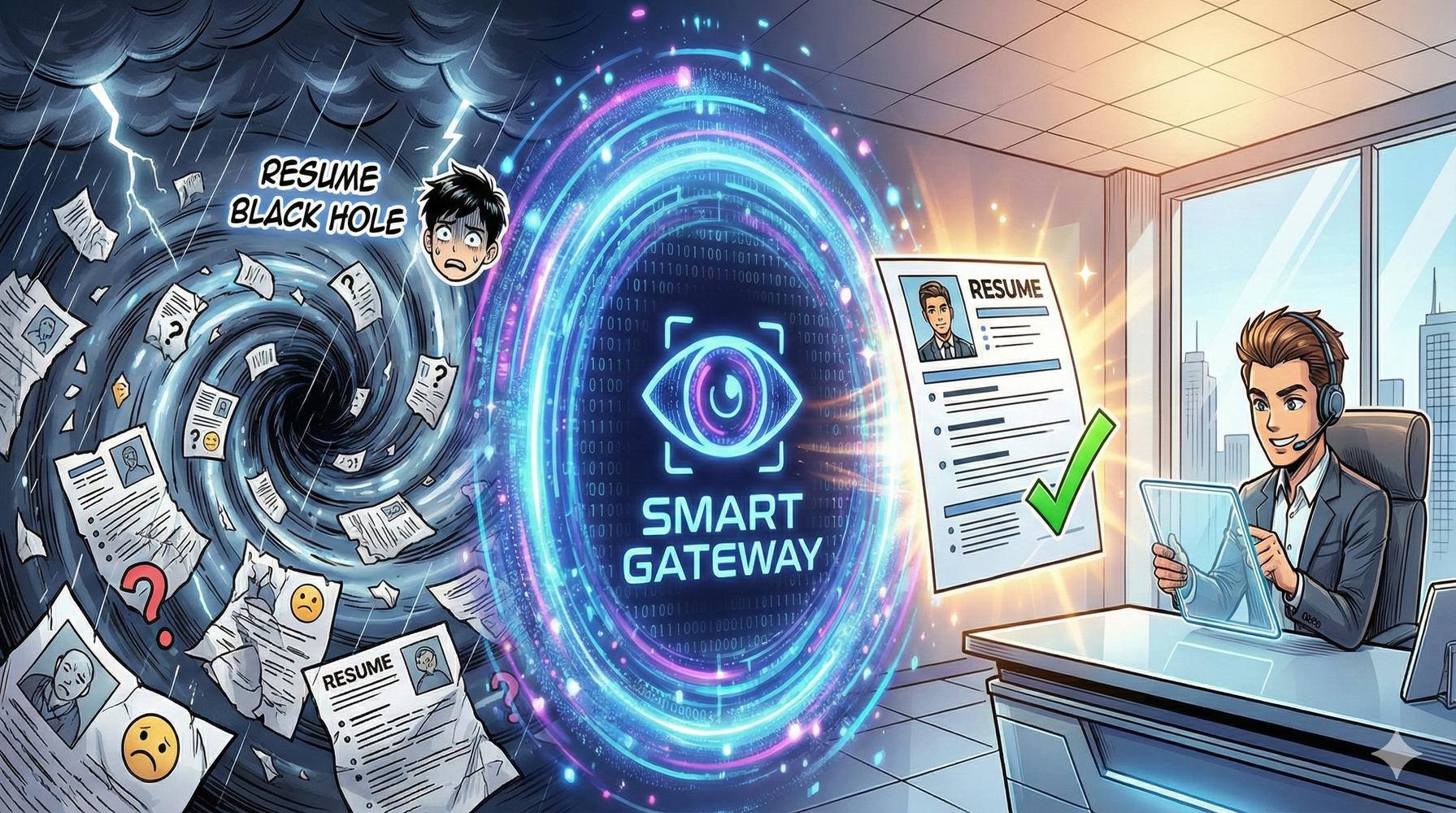
So you hit “apply” again, cross your fingers (again), and wait. And wait. And then… crickets. You start wondering if your resume just vanished into some mysterious cyber abyss that recruiters call the “ATS”, a mythical resume black hole that devours good candidates for sport.
But here is the truth: the resume black hole isn’t real. The system works exactly how it is supposed to. Your job is to learn how to speak the ATS’s language. Why? Because you have to navigate ATS before you can earn a human’s attention.
So, let’s pull back the curtain on what is really happening behind that “Your application has been received” email. Why? So you can stop blaming the machine for what is usually a strategy problem… on your part.
The Modern Gatekeeper
There was a time when recruiters actually shuffled through paper stacks of resumes at their desks. We would highlight names with a yellow marker and leave coffee rings on the ones we liked best. Those days are long gone.
Today, nearly every company (large, small, or barely-up-and-running) uses an Applicant Tracking System (ATS). Think of ATS like an inbox filter. It doesn’t read for style; it scans for structure and substance. So, if you look at it that way, you wouldn’t blame Gmail for sending spam to the junk folder, right? Well, it is the same concept here. The ATS is designed to help recruiters manage hundreds of resumes efficiently by filtering them for relevant keywords.
The trick (and your strategy)? Your resume has to be mathematically relevant to the machine and emotionally resonant to the human who will read it if the machine moves it forward.
Solving for the Machine (Technical SEO)
Since the goal is for your resume not to get lost in the resume black hole but be moved forward to humans, let’s focus on how to tailor your resume for ATS first. And to start? Let’s discuss the use of Canva templates.
Canva resumes are trendy. They look sleek, professional, and downright beautiful when you are printing one for your mom’s fridge. But applicant tracking systems? They see those split columns, icons, text boxes, and progress bars as gibberish.
Your resume doesn’t need to look like the front page of a design magazine. It does, however, need to read cleanly in a plain text format. Think of the ATS like an old-school fax machine: if it can’t “read” your formatting, it spits out nonsense.
Formatting over flair.
Stick to standard fonts (Calibri, Arial, Helvetica). Avoid tables and text boxes. And keep the format to a single column. The system cares about aligning your content with job-related keywords… not whether your headings have gradient text.
Speaking of keywords…
This is where most people miss the mark. Every job post has three layers of language:
-
Hard Skills: tangible, teachable items like SQL, project management, and budget forecasting.
-
Tooling Keywords: the brand names and systems that support those skills, like Asana, Salesforce, Adobe Premiere Pro, or Google Analytics 4.
- Soft Skills: your ability to effectively work well and interrelate with others, such as public speaking, leadership, collaboration, or organization.
Here is the trick: you must mirror all three. If a posting says they want someone skilled in “data visualization tools like Power BI or Tableau,” include those names exactly as written (if you have the experience, of course). The ATS isn’t intuitive. Therefore, it doesn’t know that “data dashboarding” could mean the same thing.
And, yes, let’s settle this once and for all: .docx wins in today’s applicant tracking systems. PDFs can work, but not all PDF versions are the same. And, not all parsing software handles them gracefully. Especially when the PDFs have been exported from design-heavy builders. Unless directions say otherwise, stick with a clean Word document that will translate cleanly into whatever system it hits.
What do humans prefer? Well, according to several sources, around 75% of recruiters still prefer Word documents for their reliability in ATS parsing. We do… So, keep it simple because both humans and automation love clarity.
Solving for the Human (The 6-Second Scan)
Let’s say your resume cleared the ATS filter (well done!). Now you have about six seconds to catch a recruiter’s eye. Literally. Landmark studies from Ladders.com have confirmed that recruiters spend less than ten seconds on the initial scan of your resume.
I can agree with that.
And where do their eyes land first? The top third of your resume. Meaning: you have to hook them there because that is where career decisions are made.
So if your resume still opens with an outdated “Objective Statement” that says something like “To obtain a position where I can utilize my skills and gain experience,” delete it right now. That statement tells the reader what you want, but not a darned thing about what you do.
And spoiler alert: Recruiters and hiring managers are scanning for what you can do…what you bring to them.
Replace it with a Professional Summary that focuses on value. For example:
Strategic marketing professional with 8+ years driving growth through data-informed campaigns, cross-functional collaboration, and creative storytelling. Passionate about connecting brand vision to measurable results.
That kind of language hits both sides of the equation: credibility and connection. The machine read it for “data-informed campaigns.” The human felt the energy behind “connecting brand vision to measurable results.”
The Content Transformation (Duties vs. Accomplishments)
Now comes the section where most job seekers lose their momentum: the bullet points.
Here is what usually happens: someone copies and pastes their job description into the resume like it’s an employee handbook. It drives me a little crazy to see lists of responsibilities… and duties include…. Why? Because it tells me nothing about what you really did. It isn’t selling, it is reporting.
Shift to accomplishment-based writing using what I call the “So What?” Test. For every bullet, ask yourself: So what? Why does that matter? What changed because of it?
Instead of saying:
Managed social media accounts for company platforms.
Say:
Grew organic LinkedIn reach by 40% through a new video content strategy that generated 15 monthly leads and doubled engagement in Q3.
You didn’t just manage. You moved the needle.
If you struggle to reframe your work, try the SARB framework: Situation, Action, Result, Benefit.
-
Situation: What was happening before?
-
Action: What did you actually do?
-
Result: What measurable outcome came from that?
-
Benefit: Why does it matter to the business?
Example:
(S) Company content engagement was declining. (A) Developed a targeted video campaign highlighting customer stories. (R) Engagement rose 40%, (B) strengthening brand awareness and lead quality.
The magic? Those sentences sound like results, not just responsibilities.
Conclusion: The Living Document
Your resume isn’t a tombstone. It is a living, breathing document that evolves every time you learn a new skill, complete a milestone, or shift your career direction.
Stop treating it like a one-and-done PDF. Make it a working file. Something that grows with your experience and keeps pace with your big ambitions. Update it quarterly, change your focus keywords when you pivot industries, and tailor it per job (yes, even slightly).
Here is your quick “Immediate Action” Checklist:
- Strip the fancy templates and aim for parsing simplicity.
- Mirror hard-skill, soft-skill, and tooling keywords… verbatim.
- Save as .docx unless told otherwise.
- Lead with a results-driven summary instead of an objective.
- Rewrite bullets through the “So What?” lens.
- Keep the SARB framework in your back pocket.
- Refresh your resume quarterly because your story is always improving.
The bottom line? The resume black hole isn’t some villain out to ruin your career. It is just technology doing its job. Your mission is to make sure your resume does its job: telling a clear, confident, keyword-smart story that guarantees that you are found and remembered.