
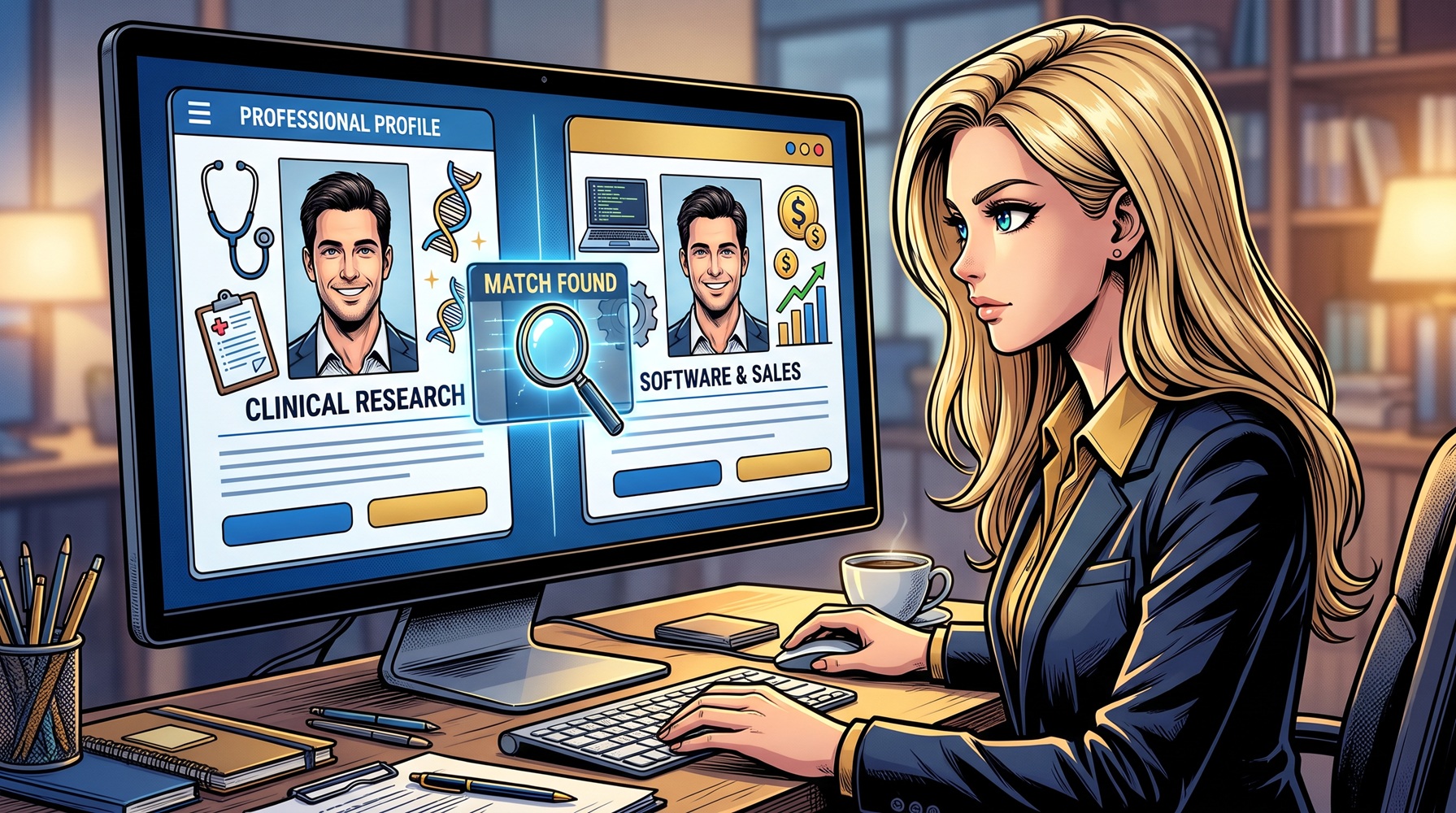
Last week, a professional reached out to me. Before I replied, I did what our team does with every profile we review. I ran his photo through Google Lens.
His face came back on a profile that wasn’t his. Same photo, someone else’s name. Somewhere, a stranger was using his face to present themselves as someone they aren’t.
The candidate who reached out to me…well, I am certain he was the real one. He had done nothing wrong. And I am sure he didn’t know what someone was doing with his picture… or what it might cost him the next time a recruiter or hiring manager came across both profiles and had to decide which one to believe.
So I told him.
A stolen photo can do real damage to the person it belongs to, and he deserved the chance to protect himself.
That conversation has stayed with me, because it is the part of this problem nobody talks about. We spend a lot of time worrying about fake profiles fooling hiring teams. But fake profiles also hurt real people: the professional whose face gets borrowed. And…it also hurts every genuine candidate who gets pushed further back in line by applicants who aren’t who they claim to be.
But Let’s Look At It Another Way
Around the same time, a different candidate showed me the other side of candidate fraudulence. She reached out to one of our company pages and asked our team to represent her. When I looked her up in our database, I found we had already removed her from our candidate pool. She had sent us two very different resumes over the years, and the one from five years ago described completely different foundational experience than the one she was using now.
Her LinkedIn profile didn’t match either of them.
When I explained that we couldn’t move forward, she acted as if she had no idea the documents conflicted. Then she told me I should give her a chance because she was a real person, and she could prove it. She had verified her LinkedIn profile with a government ID. But when the credentials don’t line up, why would I care that the profile is verified? Verification told me she was a real person. But it told me nothing about whether her history was real.
One of these situations was a real professional whose identity was being used by someone else. The other was a real person with a history that didn’t hold together. Telling them apart is the whole job, and it starts with knowing what a fake LinkedIn profile actually looks like.
Fake Doesn’t Only Mean “Not a Real Person”
When most people picture a fake LinkedIn profile, they picture a person who doesn’t exist. But that is only one kind. The other kind of ‘fake’ belongs to a real person whose history isn’t real: the person exists, but the experience, the dates, the degree, or the references don’t.
Both kinds are common. In our own screening at craresources, roughly 20% of CRA applicants are AI-generated ghost candidates, people who don’t exist at all. LinkedIn sees the same problem at a much larger scale: its own Community Report shows it stopping tens of millions of fake accounts at sign-up every six months. And another 60% of the applicants we screen are real people who have falsified all or part of their record.
For a hiring manager, both kinds cost the same: time, trust, and the risk of putting the wrong person on your study. Both types of ‘fake’ are also built to pass a quick glance. The good news is that a few minutes of careful reading catches most of them, and the signs below show you where to look.
The Signs of a Fake LinkedIn Profile
1. The profile doesn’t match the resume
This is the sign we see most often, by far. Put the resume and the LinkedIn profile side by side and compare them line by line: titles, companies, and month-and-year dates.
Obviously, small differences happen to real people. A job title that was renamed, or a start or end date that is one month different between the two job search assets, is usually an innocent slip. But different employers, dates that have significantly shifted, or entire roles that appear on one asset and not the other, tell you the candidate is telling two different stories. Sometimes even the name doesn’t match.
A real person’s career is one story. And when the documents tell two stories, at least one of those stories isn’t true.
2. The photo belongs to someone else
This is how I found the stolen photo I described at the start, and it is one of the most useful habits a hiring team can build. In Chrome, right-click the profile photo and choose Search this image with Google Lens.
Go to my LinkedIn and try it on my own photo. You will find it on ACRP’s website, on the craresources blog, my coaching site, and on other industry sites where I have written or spoken. That is what a real professional looks like. The name matches, the industry matches…everything aligns.
What you are looking for is conflict: an exact match on a site where the same photo has a different name attached, or belongs to the same person in a completely different industry. You can also check the Visual matches tab, which finds the same person in different photos. Be careful there, because people can look alike, and you need to be sure it is the same person before you draw any conclusion. But we have found the same face on several LinkedIn profiles with completely different names and work histories… and one person can’t have lived all of those careers.
Watch for AI-generated faces as well. In 2022, researchers at the Stanford Internet Observatory identified more than 1,000 LinkedIn profiles using computer-generated faces. The tells they described included eyes positioned perfectly in the center of the image and details that didn’t make sense, like a single missing earring or a strange, blurred background. The technology has improved since then, so a face that looks almost too perfect deserves a second look.
3. The history has been rewritten
A real LinkedIn profile grows over time. New roles get added, and old ones stay put. When we see an earlier version of the same profile, with the same link and the same photo, we expect it to match the current one, plus whatever has happened since.
You would be surprised how often it doesn’t. The education and employment look similar at first glance, but the details have shifted. Dates have been stretched to cover a job that has since disappeared from the profile. A Bachelor of Arts on the earlier version has become a Bachelor of Science on the current one, because a science degree looks more competitive for a clinical role.
Careers get updated. They don’t get rewritten.
4. A brand-new profile claims a long career
A candidate who claims fifteen years in clinical research but whose profile was created a few weeks ago deserves a closer look. LinkedIn’s About this member panel, which you can open from the More button on a profile, shows details like when the member joined. Real careers usually leave a longer trail.
There are legitimate exceptions. Some people delete an old account and start over, and some never used LinkedIn until they needed it. A new profile alone proves nothing, but combined with other signs, it adds up.
5. The network doesn’t fit the career
Look at who the candidate is connected to. A CRA with years in oncology is usually connected to people at CROs, sponsors, sites, and to other CRAs. Clinical research is a small world, and the people in it tend to know each other. A profile claiming that career but connected mostly to people in unrelated industries, or to very few people at all, doesn’t look like the career it describes.
6. There is no activity, ever
Many excellent CRAs never post, and that is fine. But real people still leave small traces over time: a reaction here, a comment there, an article they shared years ago. A profile that has never interacted with anyone or anything looks less like a person and more like a placeholder.
7. The About section could belong to anyone
A real About section has specifics in it: phases, indications, systems, and a story only that person could tell. A generic paragraph full of polished phrases like “results-driven” and “passionate about excellence” could have been written by anyone, or by an AI tool, in seconds.
On its own, generic writing isn’t fraud. Plenty of real people write bland About sections. But a fake profile almost never has a specific one, because specifics are hard to invent and easy to check.
8. The recommendations and endorsements come from empty accounts
Recommendations can be one of the strongest signals on a profile, which is exactly why fake profiles try to have them. Fake accounts can recommend and endorse each other, and the AI-generated profiles the Stanford researchers found were operating as a network, not as isolated accounts. LinkedIn has said publicly that it is working against artificial engagement, including activity from fake profiles.
So don’t just count recommendations. Click through to the people who wrote them. A recommendation from a former manager with a full, real history in clinical research means something. A recommendation from an account with no photo, no history, and no connection to clinical research means very little, and several of them together should make you curious.
9. The verification badge is the wrong kind of comfort
LinkedIn’s verification badge is useful, and it is worth knowing which type you are looking at. Identity verification confirms that a real person with a government ID created the profile. Workplace verification confirms that the person has an email address at their current employer.
Neither one confirms that the work history is true. The candidate who told me to give her a chance because she was verified is proof of that. A missing badge on a senior profile is a reason to look closer, not proof of a fake. And a badge on a profile full of other flags doesn’t cancel those flags out.
Build a Red Flag List and a Pink Flag List
Some of the signs above are serious enough to end a candidacy on their own. Others only matter when they stack up, because plenty of real, excellent CRAs have thin profiles. I never want a hiring team to reject a genuine candidate over one thin spot on a profile. That is why I recommend every hiring team agree, ahead of time, on two lists.
Red flags are your deal breakers. These are the findings that end a candidacy on their own. Your team decides what belongs here, but common examples include claiming to have worked for a company before it existed, listing a degree from a diploma mill, or a LinkedIn profile that seriously conflicts with the resume.
Pink flags are the things that stack. On their own, they won’t cause a rejection. But as they add up, they might. Examples include a small mismatch in one employment date, a missing profile photo, an empty About section, or one or two recommendations from empty or unrelated accounts sitting alongside several from real, relevant people.
Write both lists down and use them every time. When everyone on your team works from the same criteria, your decisions are consistent from one candidate to the next, they are easier to explain, and they are fairer to every candidate. Clear, documented criteria also help protect your team from claims that a decision was made for the wrong reasons.
Your Own Profile Is Being Read, Too
Fake profiles aren’t only a job seeker problem. There are fake recruiter and fake hiring manager profiles on LinkedIn too, and experienced CRAs have learned to be careful about who they respond to.
That means strong candidates are checking you the same way you check them. Make sure your own profile is complete, current, and clearly connected to your company, with a real photo and verification turned on. Run your own photo through Google Lens while you are at it. The last thing you want is for a great CRA to decide your message looks suspicious and move on… or to find out someone else has been using your face.
In a Nutshell
A fake LinkedIn profile is built to survive a quick glance, but it rarely survives a careful read. Compare the profile with the resume. Search the photo. Look at when the profile was created, who the person is connected to, evaluate their activity, and assess whether their recommendations come from real people. Treat verification as confirmation that someone is real, not that their history is.
Then decide, as a team, which findings are deal breakers and which ones stack, and apply those lists the same way every time.
Every careful check protects more than your study. It protects people like the professional whose face someone else was using, and every candidate who is exactly who they say they are. They are the ones fake profiles push to the back of the line, and they are the ones worth finding.