
A fake recruiter messaged me on LinkedIn.
“I came across your profile and was very impressed by your background,” she wrote. “I am a senior recruiter at [a large, well-known staffing company] and would like to speak to you about opportunities that align with your experience.”
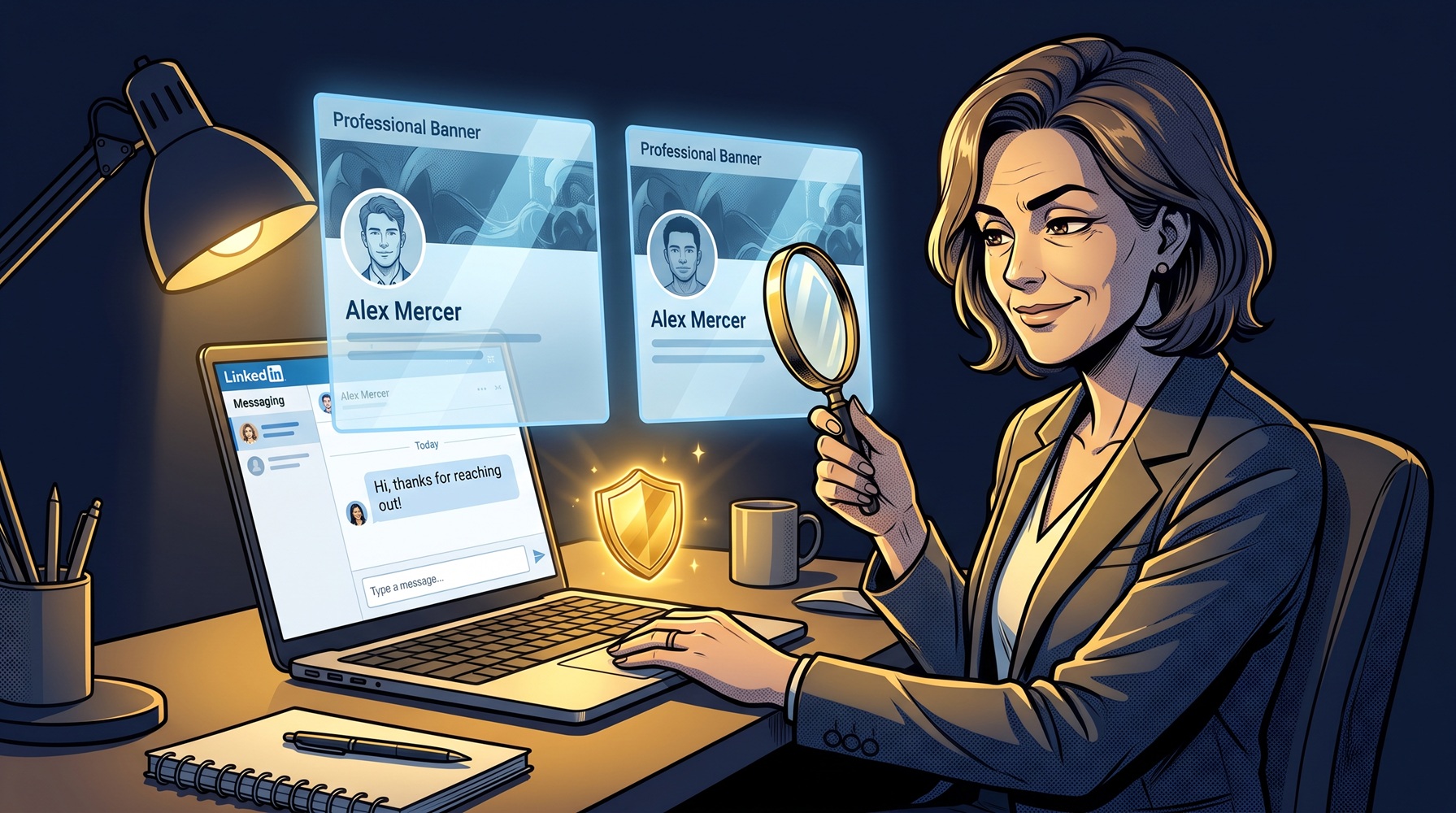
She chose the wrong person. I recruit clinical research professionals for a living, so for me, her profile fell apart in minutes. Even though she represented decades of recruiting experience, she had a single-digit number of connections and followers. Her profile was created the same month she messaged me, and her photo didn’t appear anywhere else online when I ran it through Google Lens. When I searched her name, I found a second fake profile with the same name, the same banner, and the same location, but a different face… created two months earlier. She had even asked to join our recruiting group on LinkedIn, looking for more people to target. I reported both profiles and blocked them.
That message wasn’t written for me. It was written for the CRA who has been out of work for months and checks LinkedIn every morning hoping something has changed. It was written for the Site Manager who was laid off last week and is still trying to figure out how to tell the family. To a person trying to figure out how to get found and be considered, “I was very impressed by your background” doesn’t look like a red flag.
It looks like hope.
That is what makes me angry. Recruiter scams target people when they are most worn down and most in need, and they use a person’s hope against them. The people running them deserve…Well, I don’t even know how to articulate what I believe they deserve. But the people they target deserve to know exactly what these scams look like.
The Engineer Who Wanted the Job
Some scammers are sloppy, like the one who messaged me. But the dangerous ones are patient.
A software engineer at Binance, the world’s largest cryptocurrency exchange, was looking for his next role. According to Binance’s account, reported by The Hacker News, a “Project Director” reached out to him on a legitimate job-hunting platform and set up an interview.
The first round was a live video call with a warm, friendly HR representative. The representative even shared a social media account, full of personal photos and videos, so he could see this was a real person with a real life. But the HR representative was a fake. The second round was with the company’s “CEO,” over a popular chat app. Near the end of that conversation, the CEO asked him to download a take-home assignment and set it up on his work computer. In his field, take-home assignments are a normal part of interviewing, so he did what was asked.
But the company didn’t exist. The assignment was malware. And the access it gave the attackers led to a theft of more than $6 billion.
He wasn’t careless; he just wanted a new job. He met people who looked real, and he followed a process that looked exactly like the hiring process he expected. As one cybersecurity expert told HCAMag, each stage in the interview and qualification process was built to lower his guard a little further, and by the time he was asked to complete the assignment, trust had been built over weeks. Every warning sign was there. But they were spread across a long, friendly process, which made them easy to miss for someone who wanted the job opportunity to be real.
What Fake Recruiters Are After
The resume scams aimed at clinical research professionals usually want one of three things from you.
- Your personal information. A fake recruiter asks for your Social Security number, a copy of your driver’s license, or your bank details “for onboarding” before you have had a real interview or a written offer. The Federal Trade Commission warns that scammers ask for exactly this kind of information early.
- Your money. Some scams ask you to pay for training, a certification, or equipment, with a promise that you will be reimbursed. The FTC is clear that legitimate employers never ask you to pay to get a job.
- Access to your computer. A fake recruiter sends a file, a program, or an “assessment” for you to download and run, exactly like the one that cost Binance billions.
The FTC has also warned that scammers impersonate well-known companies to recruit for fake jobs on LinkedIn and other job platforms, which is exactly what the fake recruiter who reached out to me was doing.
Check the Recruiter Before You Reply
You don’t need to be a recruiter to run the same checks I did. They take a few minutes.
- Count the connections. A real recruiter at a large staffing company usually has hundreds or thousands of connections, because building a network is the job. A senior recruiter with only a handful is a warning sign.
- Check the profile’s age. Open the More menu on the profile and select About this profile to see when the member joined LinkedIn. A brand-new profile with a senior recruiting title doesn’t add up.
- Search the photo. In Chrome, right-click the profile photo and select Search with Google Lens. A photo that shows up under a different name means the profile is fake. A photo that shows up nowhere isn’t proof on its own, but next to other warning signs, it matters.
- Search the name. Scammers often create several profiles at once. That is how I found the second fake profile.
- Reread the message. A real recruiter names the role, your experience, and why the two fit. “I came across your profile and was very impressed by your background” could be sent to anyone, because it is.
- Verify the company yourself. Find the company’s website or careers page on your own, not through a link or phone number the recruiter gives you, and confirm the recruiter and the role are real.
I covered more of these signs from the hiring side in How to Spot a Fake LinkedIn Profile. The same signs that expose a fake candidate expose a fake recruiter.
Stop and Verify When You See These
Even when a profile looks real, receiving any of these requests means you should stop and verify before going any further:
- Moving the conversation to WhatsApp, Telegram, or another chat app before a real interview
- An email from Gmail, Yahoo, or another personal account instead of the company’s own domain
- An interview held only by chat or text
- A job offer before you have spoken with anyone about the role
- A request for your Social Security number, bank details, or driver’s license before a written offer
- A request to pay for anything, or to deposit a check and send part of the money somewhere else
- A file, program, or “assessment” to download and run on your computer
- Pressure to decide right away
A real recruiter will respect you for taking a day to verify who they are. A scammer will not.
When You Spot a Recruiter Scam, Report It
Stop replying, and don’t send anything else. Report the profile to LinkedIn using the Report or block option in the More menu on the profile, as LinkedIn’s help page on fake profiles explains. LinkedIn updates its menus from time to time, so the labels may differ slightly, but the report option will be available to you. Then, always block the account.
And warn the people around you. Fake recruiters message many people in the same field at once. A quick note to a former colleague or a group you belong to can protect someone who is just as hopeful, and just as tired, as you may be.
A Word About Open to Work
LinkedIn’s Open to Work feature has two settings, and neither one shows your status only to legitimate recruiters.
The green banner on your photo is public. Anyone who views your profile can see it, including every scammer looking for someone in a job search. The private setting is labeled ‘Recruiters only,’ but according to LinkedIn’s help page, it is visible to people using LinkedIn Recruiter, a paid LinkedIn product. Other premium accounts, like Sales Navigator (what I use), can’t see it or search for it. That means the people who see your private Open to Work status are the people who pay for LinkedIn Recruiter, and paying for a product doesn’t make someone a real recruiter.
The key is that legitimate recruiters using the LinkedIn Recruiter premium account notice it… But so do scammers, because it tells them exactly who is looking.
They see you as prey.
I don’t want to go on record that you shouldn’t use the Open to Work feature, but I will say this: Real recruiters find qualified people by searching what is in their profiles. We don’t search for talent using ‘Open to Work’. We search for talent using key skills and qualifications that are on a fleshed-out profile.
A strong, complete profile does more to get you found than any banner will. Know what the Open to Work feature does, use it only when it feels right for you, and stay alert to the messages it brings.
You Deserve Real Opportunities
A job search is hard enough without people trying to take advantage of it. You deserve real recruiters, real roles, and real conversations, and knowing how to spot the fakes protects all three.
That is part of the work we do through both our recruitment and Career Coach & Job Search Mentoring divisions. We help experienced clinical research professionals build LinkedIn profiles that get found by the right people, and understand how real recruiting works from the inside. Our recruitment team, free community, live sessions, and coaching programs each offer that support at different levels.
As always, let me know how I can help.
To Your Success,
Angela Roberts, Managing Partner of craresources