
CRA Hiring:
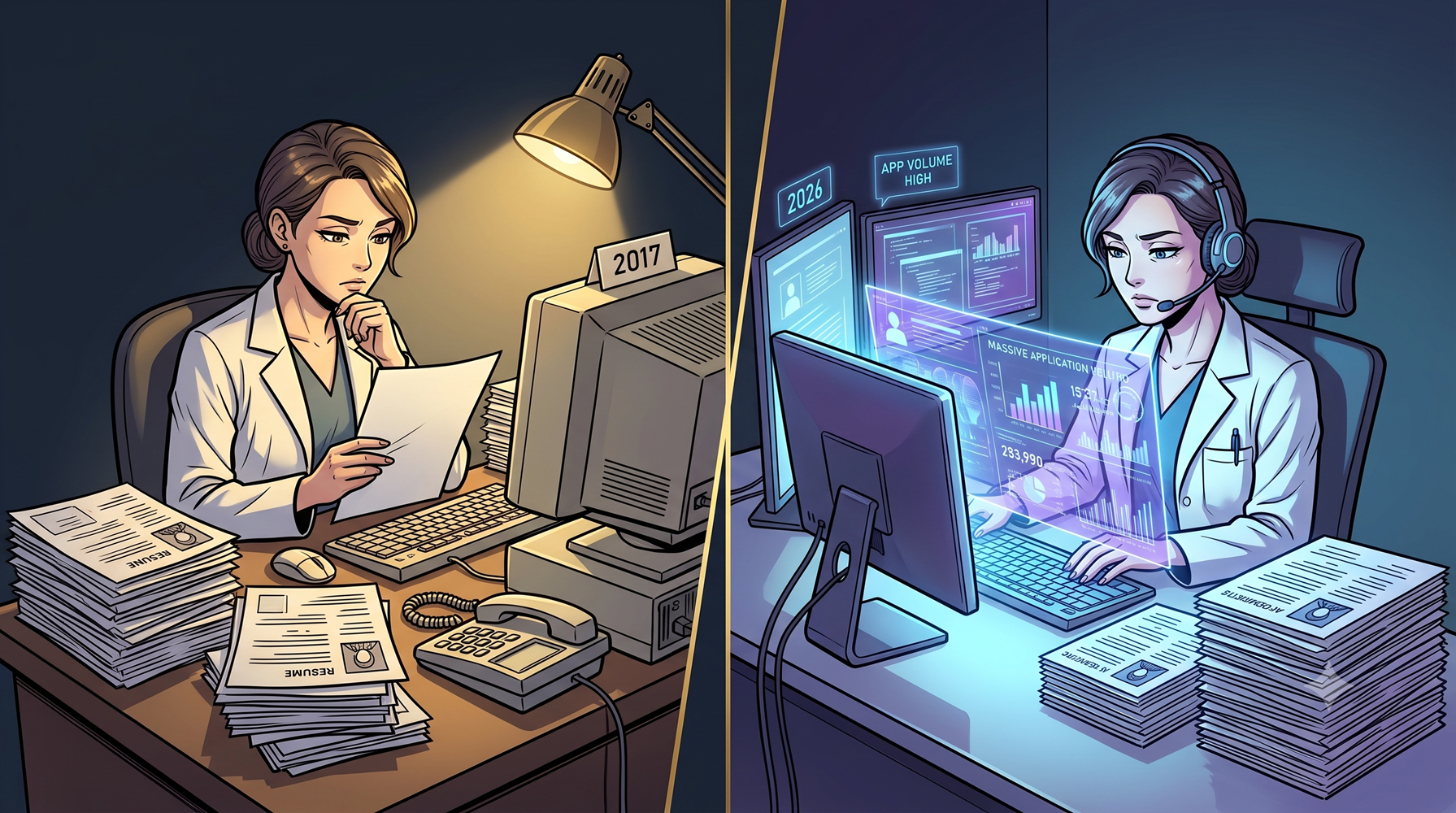
Originally published April 28, 2017. Refreshed for 2026 with current data.
I wrote this article in 2017 because I was reading too many industry pieces claiming a “concerning global shortage of experienced CRAs.” Drug Discovery and Development had reported 14,000 open CRA positions on Indeed.com alone. The narrative regarding a broken CRA hiring process was getting louder, and I disagreed with how people were diagnosing the problem.
Nine years later, I still disagree. The fraud, the noise, and the structural sourcing problem have all gotten significantly worse, and the shortage explanation has only gotten more popular.
There isn’t a shortage of high-quality, experienced CRAs. There is a structural reason hiring managers aren’t effectively navigating the CRA hiring landscape, and the reason hasn’t changed in nearly a decade. What has changed is that the structural problem now sits inside an application pool so noisy that even good hiring teams cannot work their way through it.
I will let that sit a moment, and for the sake of saying something contrarian, I will repeat it. There isn’t a shortage of high-quality, experienced CRAs.
The Three Reasons That Held Up for Over Nine Years
First, the “build it and they will come” model doesn’t work for high-quality CRAs.
This statement was true in 2017, and it is true now. The caliber of CRA you actually want to hire isn’t sitting at home refreshing job boards. Their reputations precede them. They move from one assignment to the next on the strength of referrals, networks, and relationships that took a decade (or more) to build. The way to engage them is to know when their current project is wrapping up and reach them before someone else does.
And the only way to do that is to already have a relationship with them.
For perm roles, the equivalent reality plays out differently but ends the same way. The experienced CRAs you want are currently employed somewhere else, doing solid work, and quietly thinking about their next move. They aren’t applying to your post either, because in our small industry, the cost of being caught looking outweighs the appeal of your position.
Either way, they won’t see your post… because they aren’t looking for it.
Second, the candidates who do apply are increasingly problematic.
This was the polite version of what I observed in 2017. In 2026, the data is brutal.
In our CRA intake screening, we are seeing roughly 60% of applicants who have falsified all or part of their credentials. This means fake employment, fake education, or fake references. Additionally, we are seeing another 20% who appear to be AI-generated ghost candidates. That leaves about 20% who are genuinely real professionals with real qualifications. But …that doesn’t necessarily mean they are qualified for your particular position.
The published research confirms the direction. Checkr’s 2025 survey of 3,000 hiring managers found that 31% have personally interviewed a candidate using a fake identity. Greenhouse’s 2025 AI in Hiring Report found that 65% of US hiring managers have caught applicants using AI deceptively. Deepfake interview fraud jumped 1,300% from 2023 to 2024. Gartner projects that by 2028, one in four candidate profiles worldwide will be fake.
What we are seeing in CRA hiring is consistent with the broader pattern. But it is important to note that in a small, specialized industry like ours, it is arguably ahead of it.
Third, high-quality CRAs are passionate about their work, and they gravitate toward companies that respect that passion.
This was true in 2017, and it remains the deciding factor in retention. Companies that treat CRAs as nameless monitors hired to hit metrics have high attrition. Companies that align with the deeper purpose of the work, making a difference for patients, build the kind of reputation that draws top talent without ever posting a job.
Don’t misread me. Metrics matter. Budgets matter. Timelines matter. High-quality CRAs understand all of that, and the best ones manage it as well as anyone. But their passion sits with the patients, and they will choose the company whose passion sits there too. Every time.
What Has Changed Since 2017
Three things, and all three make the case sharper.
The first is volume.
The 14,000 open CRA positions stated on Indeed in 2017 look quaint now. Job posting volume has multiplied, and a meaningful percentage of those postings are ghost jobs. Research from 2024 and 2025 estimates that 18% to 27% of online job listings are ghost jobs, posted to maintain a pipeline presence, signal growth, or test the market rather than to hire. When you measure hiring health by application volume against open requisitions, you are measuring noise against noise.
The second is AI.
In 2017, the candidates I called “problematic” were either always looking, under-qualified, or falsifying credentials. The fraud was manual and detectable with a careful reference check. Now AI generates polished, ATS-friendly resumes that pass keyword screening, deepfake technology fakes interviews, and synthetic identities clear background checks built for a pre-AI world.
The infrastructure most hiring teams use to evaluate candidates was designed before any of this existed.
The third is post-COVID hiring dynamics.
The clinical research labor market has been through several rounds of disruption, including hiring slowdowns at major CROs, reorganizations across mid-sized pharma, and quiet project shelving. The result is that the experienced CRAs you want are even more inclined to stay where they are than they were in 2017, because the cost of a wrong move feels higher than ever. We call that job hugging, and it is its own full conversation.
What the 2017 Two Questions Look Like in 2026
In the original article, I challenged hiring managers to evaluate two things. I am going to keep them because they still apply, but I am updating them for the current reality.
One: What are you doing to engage the CRAs who aren’t applying because they don’t have to?
This was the question in 2017, and it remains the question. The answer requires sourcing from networks, referrals, and trusted partners, not from your application pile. Reaching passive, employed, high-quality CRAs is a full-time discipline. If your team is not built for it, hire a firm that is. CRA hiring is important enough to have a specific focus on it.
Two: What is your reputation as a Hiring Authority signaling to the candidates you want?
Your brand reaches CRAs long before your job post does. The companies whose names get whispered as “good places to land” build that reputation through how they treat their teams, how they handle protocol problems, how they pay, and whether they protect the passion their CRAs bring to the work. None of that is marketing. All of it is recruitment.
In Closing
I had over 12,000 seasoned, tried-and-true high-quality CRAs in our network when I wrote this article in 2017. We are at well over 21,000 today, and the discipline of maintaining those relationships has only gotten harder and more valuable.
If you are still hiring through the application pile and still telling yourself the problem is a talent shortage, I would gently suggest the problem is not the talent.
As always, let us know how we can help. If you keep recruiting the same way, you will keep getting the same results. What do you have to lose by trying a different approach?
To Your Success,
Angela Roberts, Managing Partner of craresources
Angela, are you speaking about Perm CRAs or Contractors?
Susan, I am speaking to both. Recruiting a High Quality CRA that is a permanent employee is different than recruiting someone who is a consultant (i.e., different methods are employed). But I will note two important points:
1) High Quality CRAs that are employees are concerned with career growth. Because of this, they are typically “passively searching” and will therefore be open to opportunities if that means they can move forward in obtaining their career goals.
2) High Quality Consultant CRAs are concerned with finding their next contract. Although they are snatched up quickly (and rarely have to truly search for a new contract), they know they will need to transition to a new gig at some point. That is why networking with these individuals and understanding their position requirements and availability is critical. We say it all the time: “It is all about timing”.
Ang
But aren’t contract CRAs expensive? I had one that told me she wanted $120 an hour – seems like highway robbery to me.
CRAs who are in this industry because they love it are not expensive (only the greedy ones are). The industry does need to pay what I consider “industry range”…but keep in mind that we can help Sponsors and CROs understand what that range is because placing CRAs is all we do – making us extremely knowledgeable in this space.
By the way, $120 per hour *is* highway robbery in my opinion. We have exceptional CRAs assigned to some extremely complex studies (including complex oncology studies) and have never charged that much.
We can help to keep your costs down. Hiring a High Quality Contract CRA makes sense if you only need someone for a specific time frame, a partial FTE, or just need someone who doesn’t need to be trained and will be efficient.
If you want more information on what we consider “industry average” hourly rates for Contract CRAs, shoot me an email (aroberts[at]craresources.com). I am here to help.
Ang
Thanks for this info. I often wondered why many are saying there is a shortage of experienced CRAs. I have never had a problem finding great CRA candidates who meets our needs.
While we are currently in early phase (therefore our needs are small), I was concerned about finding larger quantities one we move into Phase III. It is comforting to know we have options.
Bobby, hiring volume can be a different challenge. As you approach your larger studies, please feel free to reach out and I can help you identify a strategy that will be effective for your team.
Ang (aroberts[at]craresources.com)