
Job Search Goal:
You know that feeling when you’re doing everything right? Sending out applications, tweaking your resume, showing up on LinkedIn…and having a robust job search goal? Yet there is this invisible heaviness sitting right on your shoulders.
Yeah. That is job search guilt. It is like background noise that you eventually tune out, but somehow still feel rumbling underneath everything.
Even the most motivated professionals are hit by it. And the wild part? It is usually not about what you are doing wrong. It is about how you talk to yourself while you’re doing it.
Let’s unpack that.
The “Not Doing Enough” Loop
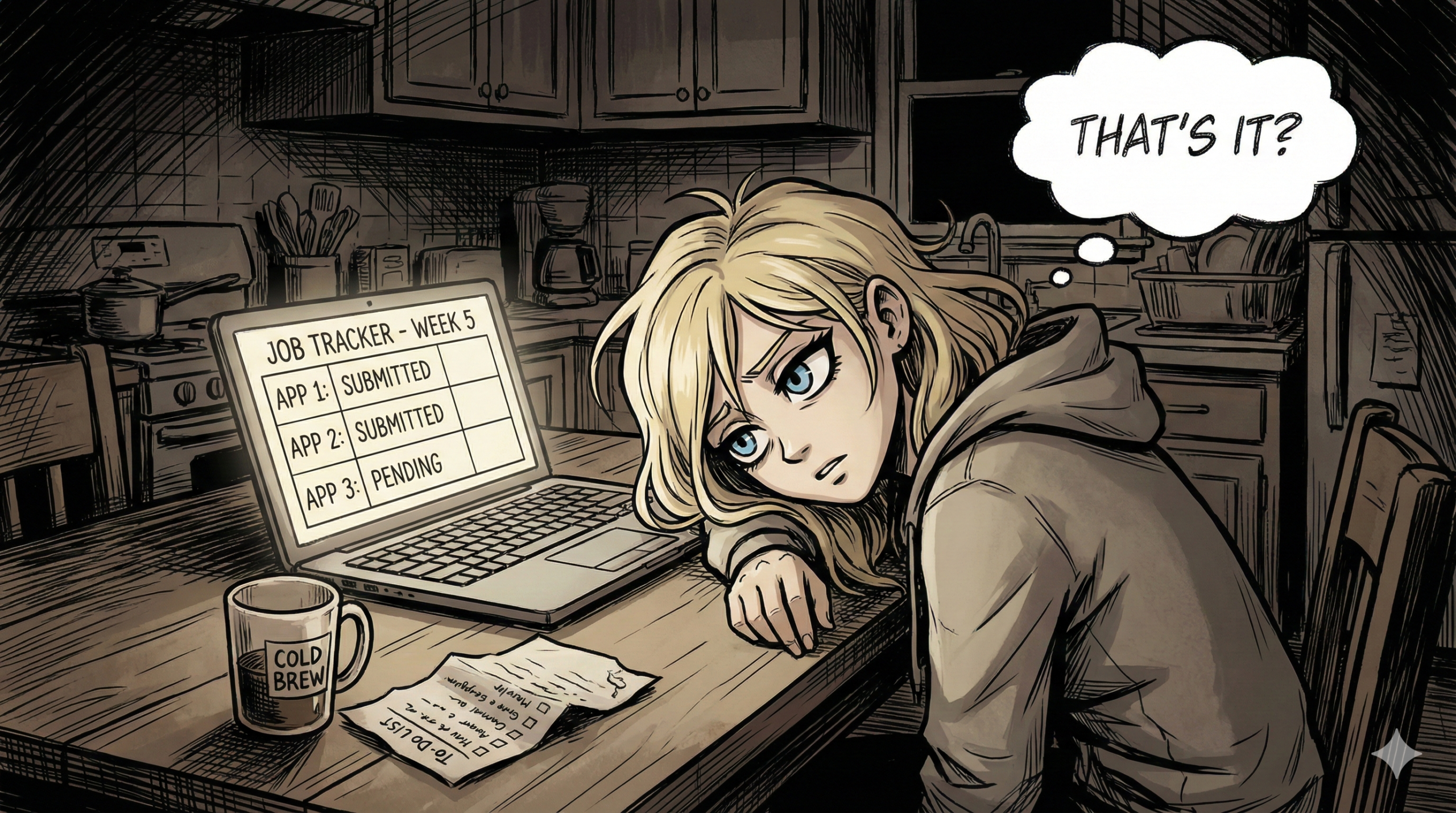
This one is sneaky. You open your tracker to three applications this week, and before you can even sip your coffee, that little voice pipes up: That’s it? You will never meet your job search goal.
Never mind that you’ve been juggling deadlines, kids, migraines, or the two‑hour round‑trip commute that eats your soul. Context doesn’t stand a chance against guilt’s favorite phrase: Other people would’ve handled it better.
And that is the trap. Because when guilt takes the wheel, logic moves to the back seat. It isn’t even about effort. It is about perfectionism in disguise. You start believing you should push harder, stay up later, move faster… but the truth?
You are already running a marathon; you have just convinced yourself it is a sprint.
The “I Don’t Even Want To” Guilt
Then there is the one nobody admits out loud. The kind where you stare down another cover letter and think, You know what sounds fantastic right now? Cleaning the junk drawer.
It isn’t laziness. It is emotional fatigue. Why? Because constantly “selling yourself” is exhausting, especially when every click, scroll, and form feels like shouting into a void. You start questioning your motivation like it is a moral issue: If I really wanted this, I would be working harder.
But no. That isn’t truth talking; that is burnout wearing a guilt mask. You are not unmotivated…you are human, and humans aren’t built to perform on command 24/7.
Sometimes what looks like procrastination is just your brain begging for recovery.
The Comparison Game You Can’t Win
Ah, LinkedIn, the digital parade of “thrilled to announce” posts that make you feel like you are standing still while everyone else sprints past. You hit “Congrats!” but inside, you’re asking, What is wrong with me?
 There is nothing wrong with you. You are seeing everyone else’s highlight reel but never the outtakes.
You don’t see the rejections, the false starts, the “cry in the car before the interview” moments. They exist, but no one posts about them.
And yet, that constant comparison feeds guilt until it feels like your only companion.
Except it doesn’t have to.
The Power of Seeing Yourself Clearly
That is where your Job Search Strategy Compass comes in. This tool isn’t just some checklist to make you “do better,” but is a map for understanding why things feel so heavy. It can help you look at your overall job search goals, rather than having a micro-focus on only one area.
Picture this: eight simple categories: clarity, personal brand, networking, applications, interview readiness, skills, mindset, and life logistics. When you look at all of them together, patterns start to pop off the page. Suddenly, guilt starts to lose its power because you can see what’s really going on.
- “I’m lazy” morphs into “My life logistics are tight this week.”
- “I’m stuck” becomes “My mindset took a hit after that rejection.”
Same data. Completely different story.
Gathering data using the Compass isn’t about blaming yourself. It is about gathering intel on your own rhythms, energy, and limits. Because once you understand them, you can work with yourself, not against yourself.
When Awareness Replaces Blame
I coached someone recently who used to call herself inconsistent every other week. Mondays and Tuesdays? Productivity gold. By Thursday night? No bandwidth left, just enough energy to reorganize the pantry instead of applying for anything.
Sound familiar? Here’s what changed everything: instead of trying to “fix” her inconsistency, she got curious. She grabbed her Compass and started tracking.
No judgment, just observation.
When did her energy spike? When did it flatline? What was happening right before she ghosted LinkedIn for three days?
 It turns out that her “lazy” days often followed emotional hits, such as stressful doctor appointments, tough family conversations, and financial surprises. We all have them…the “stuff” that drains your system quietly. Her downtime wasn’t failure; it was her nervous system tapping the brakes.
The shift from guilt to awareness changed everything.
Adjusting the System, Not the Self
Once you identify your own rhythms, you can play more effectively. Here is how she adjusted:
-
Front‑load focus tasks early in the week when her brain is sharpest.
-
Set recovery days after mentally heavy moments, focusing on light work only, like noting insights or updating one section of her Compass.
-
Cut late‑night projects. She realized nothing good came from forcing cover letters after a long day.
So simple, yet so transforming. Because the goal isn’t to bulldoze through exhaustion, it is to create a more humane rhythm that keeps you moving sustainably.
Grace as Strategy
Now, let’s talk about grace because this part matters.
Grace isn’t a weakness. It is stability. It is the oxygen your strategy runs on.
When you start treating yourself like someone worth supporting instead of someone who constantly needs correcting, everything changes. Guilt fades. Progress feels lighter. Discipline stops being punishment and starts being self-care.
You can still (and should) still have ambition and goals. And you should still hold yourself accountable. But now it comes from respect for your energy, not resentment of it.
And that inner critic? It will still whisper sometimes. The trick is learning to recognize its voice, thank it for its “concern,” and then move on without letting it set your schedule.
The Bigger Picture
Your job search isn’t just about resumes and interviews. It is about you learning how you function under uncertainty.
And that lesson is transferable…something you take with you on your next journey. Every human nervous system has limits and breaking points. Pushing harder doesn’t make you stronger, but understanding yourself does.
When you shift from “What’s wrong with me?” to “What do my patterns tell me?” you finally step into the driver’s seat of your own momentum. You stop treating guilt like a compass and start using an actual compass: one based in reality, data, grace, and awareness.
That is how you move from burnout to balance and from shame to self‑respect. Because the truth is: your rhythm isn’t broken. It is just waiting to be understood.